Blog details


Ecommerce website cost in Egypt, Saudi Arabia and the UAE in 2026: published ranges, platform vs custom store, running costs and a quote checklist.
Short answer: The cost of an ecommerce website in Egypt and the Gulf in 2026 starts at a monthly subscription on a hosted platform such as Shopify, Salla or Zid. A store built by an agency on WooCommerce or similar usually costs tens of thousands, and a fully custom store with its own backend sits at the top of the range. A custom store makes sense when your business rules, integrations or scale no longer fit a platform. Before that point, a hosted platform is often the smarter money.
By Mohamed Samy, senior Laravel/PHP backend developer (7 years). Published: 27 October 2026. Last updated: 27 October 2026.
Most store owners who contact me are not starting from zero. They already sell on Instagram, WhatsApp, or a store on a platform, and something is starting to hurt. Maybe the stock never matches the warehouse. Maybe they need wholesale prices for some customers and retail for others. Or the platform's fees grow every month while the store itself can't do what they need. The question they ask is "how much would a custom store cost?" The question I ask back is "what exactly is the platform stopping you from doing?"
This guide is for store owners in Egypt first, and then Saudi Arabia, the UAE, Kuwait, Qatar, Bahrain and Oman. It is only about online stores. If you need a company website rather than a store, our guide to custom website design cost covers that. If you want the practical steps of launching a store, see our step-by-step ecommerce guide (Arabic).
What agencies publish for ecommerce stores in 2026
I don't invent numbers. These are ranges agencies publish on their own pages, read on 27 October 2026. They are market signals, not quotes, and each agency defines "store" differently.
| Market | Published range for ecommerce stores | Source |
|---|---|---|
| Egypt | WooCommerce store EGP 30,000 to 80,000; Shopify store EGP 25,000 to 70,000 (excluding subscription); custom web app (Laravel / Next.js) EGP 80,000 to 250,000+ | Aghrba |
| Egypt | Online store with payments and inventory: EGP 15,000 to 50,000+ | SM Web Studio |
| Egypt | Advanced ecommerce store: from USD 5,000 | Webdivs |
| Saudi Arabia | Online store: SAR 4,000 to 25,000; stores with custom integrations can exceed SAR 50,000 | Hexapert |
| UAE (Dubai) | Ecommerce: AED 15,000 to 110,000+; with payment gateway and inventory, AED 25,000 to 80,000 | Upscape |
I could not find published ranges of the same quality for Kuwait, Qatar, Bahrain or Oman, so I won't quote numbers for them. The same cost drivers apply.
The jump from the low end to the high end is not about design. It's about what happens behind the "Buy" button: stock, pricing rules, payments, shipping, invoices and the systems those connect to.
Hosted platform vs agency-built store vs custom store
Golden Code does not sell ready-made stores or templates; we only build custom. So read this as a buyer's guide.
| Hosted platform (Shopify, Salla, Zid) | Agency-built on WooCommerce or similar | Custom store built from scratch | |
|---|---|---|---|
| Upfront cost | Low | Medium | Highest |
| Monthly cost | Subscription plus apps and transaction fees, per the platform's pricing (Shopify, Zid) | Hosting, plugin licences, maintenance | Hosting and maintenance; no per-platform subscription |
| Speed to launch | Fastest | Medium | Slowest |
| Custom business rules | Limited to settings and apps | Possible via plugins or custom code | Built exactly for your rules |
| Integrations (ERP, warehouse, accounting) | Through available apps | Plugins or custom code | Direct, designed in |
| Ownership and portability | Tied to the platform | You own the site, but depend on plugins | You own the code |
| Fair fit | New store, testing demand | Growing store with standard needs | Store whose operations are its advantage |
My honest advice: if you're still validating whether people will buy, start on a hosted platform. Custom becomes worth it when you can name, in one sentence, what the platform can't do for you and what that costs you.
Signs your store has outgrown a platform
- Pricing rules the platform can't express: wholesale tiers, prices per customer group, bundles with conditions, or B2B quotes.
- Stock lives somewhere else: your ERP or warehouse system is the source of truth, and syncing through an app keeps breaking.
- Several branches or warehouses: you need stock per location and orders routed to the nearest one.
- Local payments and invoicing: you need specific gateways, cash-on-delivery rules, or e-invoicing integration, such as ZATCA in Saudi Arabia (ZATCA e-invoicing) or the Egyptian Tax Authority's system (ETA).
- App fees keep stacking up: you pay for many apps to approximate one workflow.
- You need a mobile app or B2B portal on the same backend.
If none of these sound like you, keep your platform and spend the money on marketing.
What drives the cost of a custom store
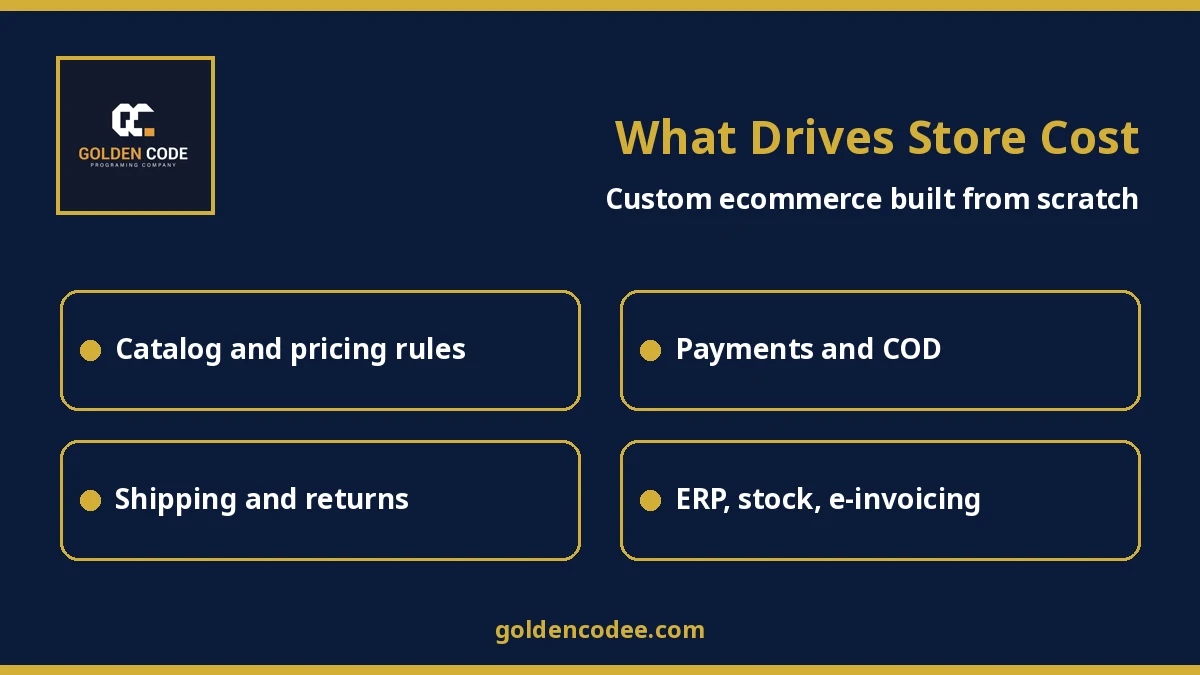
- Catalog complexity. Products with variants (size, colour), bundles, digital products or subscriptions all add logic.
- Pricing and promotions. Coupons, customer groups, wholesale prices and loyalty points are real backend work.
- Payments. Each gateway (Paymob, Fawry, Tap, Moyasar, HyperPay) and each method (cards, wallets, mada, Apple Pay, cash on delivery) needs integration and testing; our payment gateway integration guide for Egypt and Saudi Arabia (Arabic) covers this in detail.
- Shipping. Live rates, shipping-company APIs, zones and returns.
- Integrations. ERP, accounting, warehouse, CRM, marketing pixels and e-invoicing.
- Admin panel. Order management, staff roles, reports and stock control your team will use every day.
- Arabic and English. RTL design, two catalogs, and SEO for both languages.
- Performance and security. Fast pages on mobile, a secure checkout and protection of customer data.
Running costs to budget for
| Item | Notes |
|---|---|
| Hosting | Scales with traffic and catalog size |
| Payment gateway fees | Per transaction, per the gateway's own pricing |
| Shipping | Per shipment, per the courier's contract |
| Maintenance and updates | Security patches, small fixes; several published guides put it at about 10 to 20% of project value per year (Aghrba) |
| Third-party services | SMS, email, search, paid APIs |
| VAT | 15% in Saudi Arabia and 5% in the UAE on taxable supplies, per each tax authority |
How to get a store quote you can compare
Step 1: Write down how you sell today
List your products, how many you have, how you price them, how orders reach you, and how they are delivered. Plain language is fine.
Step 2: Name what your current setup can't do
Write the three to five problems a new store must solve. This is what you are paying for.
Step 3: List every system the store must talk to
Payment gateways, shipping companies, ERP or accounting, e-invoicing and any marketplace you sell on.
Step 4: Split launch from later
Mark each feature as "launch" or "phase two". A focused first version costs less and goes live sooner.
Step 5: Ask for an itemised quote
Ask for a breakdown into design, storefront, backend, each integration, testing and launch, plus the monthly running costs.
Step 6: Confirm ownership and support
Make sure the code, the hosting account and the payment-gateway merchant accounts are in your name, and agree on a support period after launch.
FAQ
How much does an ecommerce website cost in Egypt in 2026?
Published Egyptian guides put agency-built stores roughly between EGP 15,000 and 80,000 depending on platform and features, and custom web builds between EGP 80,000 and 250,000+. A hosted platform starts with a monthly subscription instead.
How much does an online store cost in Saudi Arabia or the UAE?
A Saudi guide lists online stores at SAR 4,000 to 25,000, with custom-integrated stores able to exceed SAR 50,000. A Dubai guide lists ecommerce at AED 15,000 to 110,000+.
Is Shopify, Salla or Zid cheaper than a custom store?
Upfront, yes. Over time it depends on subscriptions, app fees and transaction fees versus hosting and maintenance. Compare total cost over two or three years, not just launch cost.
When is a custom ecommerce store worth it?
When your pricing, stock, integrations or operations need rules the platform can't handle well, and that limitation costs you sales or staff time.
What is not included in the store build price?
Usually hosting, payment gateway fees, shipping costs, product photography and content, paid apps or services, and VAT. Ask for them in writing.
Can a custom store connect to e-invoicing and local payment gateways?
Yes. A custom backend can integrate local gateways and e-invoicing systems directly, which is one of the main reasons stores in Egypt and Saudi Arabia choose custom.
Sources
- Egypt: Aghrba, SM Web Studio, Webdivs
- Saudi Arabia: Hexapert, ZATCA e-invoicing
- UAE: Upscape
- Egypt e-invoicing: Egyptian Tax Authority
- Platform pricing pages: Shopify, Zid
All competitor figures were read from their own pages on 27 October 2026 and may change.
Thinking about a custom store?
If your store has started to outgrow its platform, send us a short description of how you sell and what is getting in the way. We'll tell you honestly whether a custom build is worth it now, or whether a smaller fix will do. One example of a smaller fix: our proposed payment gateway integration package is EGP 15,000. It covers one gateway (Paymob, Tap, Moyasar or HyperPay) with webhooks and order-status updates, and the final price is confirmed after scoping. Reach the Golden Code team through the contact page.
About the author: Mohamed Samy is a senior backend developer at Golden Code with 7 years of experience building custom Laravel and PHP systems, payment integrations and ecommerce backends.