Blog details



2026 custom e-learning platform and LMS costs in Egypt and Saudi Arabia, ready-made vs custom, licensing, video and running costs.
Short answer: Published 2026 ranges for a custom e-learning platform are very wide. One Arabic guide says Arab development firms quote roughly $2,000 to $5,000 for a basic custom platform. A Saudi guide puts custom development at SAR 15,000 to 80,000 upfront. International LMS firms start their custom MVPs at $15,000 to $60,000 and go past $150,000 for enterprise builds. Ready-made platforms are the cheap way to start. In Egypt, Snatr starts at EGP 999 a month for up to 100 students, and Teachable starts at $39 a month. What decides your number is not the course page. It is video protection, payments, exams, user roles, and, in Saudi Arabia, licensing and FutureX integration.
By Mohamed Samy, Senior Backend Developer (Laravel/PHP), 7 years of experience. Published: November 3, 2026. Updated: November 3, 2026.
When a teacher, a training center or a company asks me "how much for an online learning platform?", I answer with three questions. Who logs in: only students, or also teachers, parents, corporate clients and an admin team? How is the content protected: are you fine with videos being downloaded and shared, or is that your whole business risk? And how does money come in: one-off course sales, monthly subscriptions, wallet top-ups, or a company paying for seats?
Those answers usually move the price more than the design does. I work on the part behind the screen: the API, the admin panel, payments, integrations and the servers. In this guide to e-learning platform development cost, I collected the 2026 prices that platforms and development firms publish for Egypt, Saudi Arabia and international LMS projects, explained what sits behind each range, and showed how to get a quote you can actually compare. I opened every page cited here on November 3, 2026. The sources are listed at the end.
Do you need a custom platform at all?
Start with the honest question. If you are one teacher or trainer selling recorded courses to a few hundred students, a ready-made platform is usually the faster and cheaper start. You pay monthly, you launch this week, and someone else handles hosting and updates.
A custom platform starts to make sense when one of these is true:
- Your model does not fit the templates. Centers with branches, parents following their kids, codes sold through bookshops, corporate seats, or exams with your own rules.
- Per-student pricing starts to hurt. Ready platforms price by student count, products or features. At some size the monthly bill keeps growing while a custom build mostly costs hosting and maintenance.
- You need integration. Your ERP, HR system, CRM, payment gateway, WhatsApp, or a national system such as FutureX in Saudi Arabia.
- You want to own the code and the data. Students, grades and payment history in your database, not in a vendor's.
If none of this applies yet, start ready-made and move later. I would rather say that now than sell a build you do not need.
Ready-made platforms: what they cost in 2026
These are the published monthly prices from the platforms' own pages. I include them as a baseline, because a custom quote only makes sense when you compare it to what renting would cost.
| Platform | Published price | Notes |
|---|---|---|
| Snatr (Egypt) | EGP 999 / 1,999 / 2,999 per month | Up to 100 / 200 / 400 students |
| Teachable | $39 / $89 / $189 per month (billed monthly) | 7.5% transaction fee on Starter |
| Tutor LMS (WordPress plugin) | $199 per year list price for one site | Plus hosting, theme and video hosting |
Two things stand out. Ready platforms are clearly cheaper to start. And their pricing is tied to growth: student caps, product caps or transaction fees. That is fine at 100 students. At a few thousand, it is worth running the numbers.
Egypt: what a custom build costs
Egyptian firms rarely publish clear LMS price lists, so the public numbers are thin. Taalemy, a ready-made platform that compares itself with custom builds, says Arab development firms publish ranges of about $2,000 to $5,000 for an integrated custom platform, $1,000 to $2,000 for content management, registration and payment, and $2,000 to $5,000 more for a mobile app. Keep in mind that Taalemy sells the alternative, and that numbers at this level usually describe a template or a light customization, not a platform designed around your workflow.
What I see in the Egyptian market is that the real cost drivers are local:
- Video protection. Screen recording and shared logins are the biggest concern for teachers who sell recorded lessons. Watermarks with the student's name or phone number, device limits and signed video links all add backend work.
- Local payments. Cards, mobile wallets and payment by reference code at retail outlets, each with webhooks, refunds and reconciliation. I explained this in the payment gateway integration guide for Egypt and Saudi Arabia (in Arabic).
- Access codes. Many centers sell prepaid cards or codes through their own channels. That needs code generation, batch tracking and fraud checks.
- Exam season peaks. Everyone logs in the night before the exam. The server has to be sized for that night, not for an average Tuesday.
Saudi Arabia: prices plus licensing
Saudi guides publish clearer numbers, and they also add a cost Egypt does not have.
| Source (Saudi Arabia) | Custom development | Notes |
|---|---|---|
| Tamyuz | SAR 15,000–80,000 upfront | SAR 1,500–5,000 a month for maintenance |
| Edaa | SAR 200,000–800,000 or more for an integrated platform | Says FutureX readiness built from scratch "may exceed 50,000 riyals alone" (my translation) |
Both guides lean toward ready platforms: Tamyuz points most individual trainers to SaaS, and Edaa's comparison scores the ready option as the winner on most rows. The gap between their ranges shows how much depends on what "platform" means.
The licensing part matters. Amwaj Solutions notes that a license from the National eLearning Center (NELC) adds a non-refundable fee and integration work with FutureX for programs that award completion certificates. The official services are listed on the FutureX portal. If you are a Saudi entity offering licensed programs, put FutureX integration and the licensing timeline in your plan from the first day, not after launch.
International LMS benchmarks
Global LMS firms publish higher numbers, mostly because of team location and scope.
| Source | MVP | Mid / full | Enterprise |
|---|---|---|---|
| Aristek Systems | $35,000–$80,000 | $80,000–$150,000 | $150,000–$500,000+ |
| Gilzor | $60,000–$150,000 | $150,000–$400,000+ (full platform) | — |
| Enfin Technologies | $15,000–$35,000 | $35,000–$150,000 | $150,000–$250,000+ |
| KWA Digital | $8,000–$40,000 (custom frontend on Moodle) | $50,000–$300,000+ (from scratch) | — |
Gilzor makes a useful point: the team's location changes the number "by a factor of two to four for the same scope." It also says that for internal training with fewer than roughly 1,500 active learners, a license usually wins on cost alone. That matches my advice above. And KWA Digital is blunt: in its table, the "best for" entry for building an LMS from scratch reads "Almost no one, honestly." A custom frontend on top of an existing open-source LMS is often the middle path.
What actually moves e-learning platform development cost
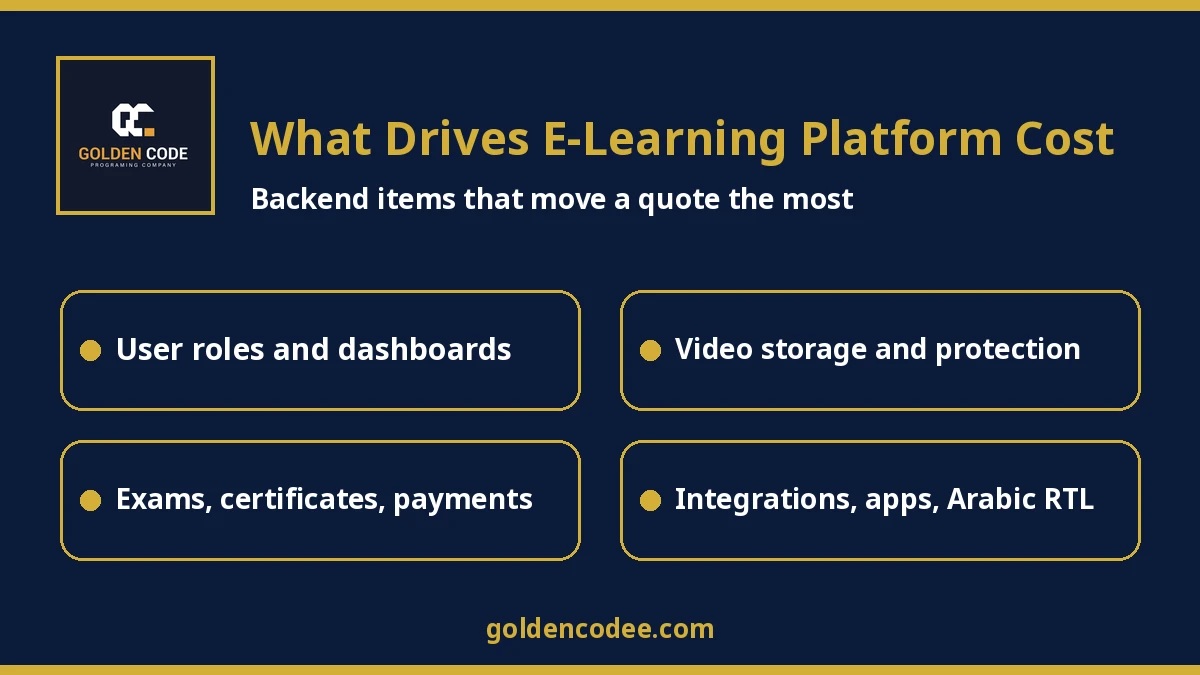
From the backend side, these are the items that change a quote most:
- User roles. Student only is one product. Student, teacher, parent, assistant, branch manager and corporate buyer means several dashboards, permissions and reports on one backend.
- Video delivery and protection. Storage and bandwidth grow with every lesson and every view. Bunny Stream, for example, lists free encoding, storage from $0.01/GB and CDN from $0.005/GB. Protection logic on top of that is custom work.
- Exams and certificates. Question banks, timed exams, random question order, manual grading and verifiable certificates.
- Payments and billing. One-off sales, subscriptions, codes, corporate seats and refunds. In Saudi Arabia, invoices may also need e-invoicing compliance, which I covered in the ZATCA Phase 2 integration guide.
- Live classes. Scheduling, attendance and recordings, usually through Zoom or a similar service rather than building video calls yourself.
- Mobile apps. A web platform that works well on phones is the first step. Native apps add a separate budget, which I broke down in the mobile app development cost guide.
- Arabic and English with RTL. Exams, certificates and reports all need to work in both directions. It is cheaper to plan this from day one.
The running costs nobody puts in the first quote
The build price is not the full bill. Plan for:
- Hosting sized for exam peaks and term starts. Amwaj Solutions makes the same point about sizing for exam weeks rather than average days.
- Video storage and bandwidth, which grow with every student.
- Maintenance. Gilzor and Edaa both cite 15–20% of the build cost per year, and KWA Digital says 15 to 25 percent. Treat this as a planning rule, not a quote.
- Payment fees on every sale.
- Content. Recording, editing and updating courses often costs more over the years than the software.
Mistakes I see when people buy a platform
- Buying a template and calling it custom. Ask what is built for you and what is a theme or plugin.
- Ignoring video protection until launch. Adding it later means reworking the player, URLs and sessions.
- Starting with every feature. Launch with the one path that brings money: sign up, pay, watch, take the exam. Add the rest after real students use it.
- Accounts and code not in your name. The domain, servers, video account, payment account and source code should belong to your organization.
- No plan for exam night. The platform that works for 50 users on a test day can fall over with 2,000 students at 11 p.m.
How to get a comparable e-learning platform quote in 6 steps
Step 1: Write the main student journey
Describe what a student does from sign-up to paying, watching a lesson and taking an exam. One page is enough. That is your first version.
Step 2: List every user role
Student, teacher, assistant, parent, branch admin, corporate buyer, super admin. For each, write what they see and what they can do.
Step 3: Decide how content is protected
Watermarks, device limits, download rules and how many concurrent sessions are allowed. This changes the backend design, so decide it before the quote.
Step 4: List payments and integrations
Payment methods, access codes, invoices, WhatsApp or SMS notifications, and any system you already run. In Saudi Arabia, add NELC licensing and FutureX if your programs need them.
Step 5: Ask for an itemized quote
Ask for separate lines for design, the student platform, the admin panel, video setup, payments, integrations, testing, and the first months of support. Compare line by line, not just the total.
Step 6: Confirm ownership and running costs
Make sure the code, servers, video and payment accounts are in your organization's name. Ask for a written estimate of monthly hosting, video and maintenance costs.
FAQ
How much does it cost to build an e-learning platform in Egypt in 2026?
Published numbers are thin. One Arabic guide says Arab development firms quote about $2,000 to $5,000 for a basic custom platform. Platforms with your own workflow, video protection and local payments cost more and are priced after scoping. Ready platforms such as Snatr start at EGP 999 a month for up to 100 students.
How much does a custom LMS cost in Saudi Arabia?
Published Saudi guides range from SAR 15,000–80,000 upfront to SAR 200,000–800,000 or more for an integrated platform, depending on scope. Licensed programs may also need NELC licensing and FutureX integration.
Is a ready-made platform cheaper than a custom one?
To start, yes. Ready platforms charge monthly with no build cost. Over several years, per-student or per-product pricing can overtake the hosting and maintenance cost of a custom build, so compare the total cost over three to five years.
Can I use Moodle instead of building from scratch?
Yes. Customizing an open-source LMS is often the middle path. KWA Digital lists $8,000 to $40,000 for a custom frontend on Moodle, and Gilzor lists $25,000 to $90,000 for customizing Moodle or Open edX.
What are the yearly costs after launch?
Hosting, video storage and bandwidth, payment fees, content updates and maintenance. Several published guides plan maintenance at about 15–20% of the build cost per year.
Can the platform connect to my existing systems?
Yes. A custom backend can connect to your ERP, HR system, CRM, payment gateway or WhatsApp through APIs, so you do not re-enter data you already have.
Sources
- Ready platforms: Snatr pricing, Teachable pricing, Tutor LMS pricing
- Egypt and Arabic market: Taalemy
- Saudi Arabia: Tamyuz, Edaa, Amwaj Solutions, FutureX services
- International: Aristek Systems, Gilzor, Enfin Technologies, KWA Digital
- Video delivery: Bunny Stream pricing
All sources were checked on November 3, 2026. Prices change, and these are published ranges from each company, not quotes.
Planning an e-learning platform?
Send us a short description of your students, your user roles, how you sell your courses and which systems the platform should connect to. We will tell you honestly whether a ready platform is enough for now or a custom build makes sense, and what to build first. All our work is custom. We will send a quote after we review your scope. You can reach the Golden Code team from the contact page.
About the author: Mohamed Samy is a Senior Backend Developer at Golden Code with 7 years of experience building custom business systems with Laravel and PHP, system integrations and automation for companies in Egypt and the Gulf.