Blog details


Custom WhatsApp AI chatbot for business in Egypt and the Gulf: build steps, Meta's Oct 2026 pricing, costs and data rules. Built from scratch.
Short answer: A custom WhatsApp AI chatbot for business is a bot built on Meta's official WhatsApp Business Platform (Cloud API), connected to your own systems and an AI model, so it answers customers with your real prices, stock, bookings and policies instead of generic replies. Since 1 October 2026 Meta charges for service messages after the first 1,000 per business phone number each month, so the way the bot is designed now directly affects your monthly bill, not just the build cost.
By Mohamed Samy, senior Laravel/PHP backend developer (7 years). Published: 23 October 2026. Last updated: 23 October 2026.
Almost every business owner I talk to in Cairo, Riyadh or Dubai already sells on WhatsApp. The orders, the "how much?" questions, the booking requests, the "where is my delivery?" messages all land in one or two phones. When people ask me about an AI chatbot, what they usually mean is: "I want WhatsApp to keep answering when my team is asleep, without saying something wrong to a customer."
That is a reasonable goal, and it is very achievable. But 2026 changed a few rules, and if you plan the bot without knowing them you can end up with a bill or a policy problem you did not expect. This guide is how I would explain it to a client before we write a single line of code.
What changed in 2026 (and why it matters for your bot)
Three changes from Meta matter for any business planning a WhatsApp bot this year:
| Change | Date | What it means for you | Source |
|---|---|---|---|
| Per-message pricing replaced conversation pricing | 1 July 2025 | You pay per delivered template message, by category and the customer's country code | Meta pricing docs |
| General-purpose AI assistants banned from the Business API | 15 January 2026 | ChatGPT-style "ask me anything" bots are out; AI that serves your own customers is allowed | WhatsApp Business Solution Terms, TechCrunch |
| Service messages became chargeable | 1 October 2026 | First 1,000 service messages per business number per month are free, then charged at published rates | WhatsApp Business FAQ |
Meta also lists "Meta Business Agent" as its own category, with a single token-based charge covering delivery and AI usage. That is Meta's own AI offering. A custom bot, which is what we build, uses the regular message categories, and you choose and pay for the AI model separately.
The second change is the one people misread. Meta confirmed to TechCrunch that the rule does not affect businesses using AI to serve their customers; a travel company running a customer-service bot is the example they gave. What is not allowed is offering a general AI assistant as the product itself. So a bot that answers questions about your clinic, your store or your service is fine. A bot that pretends to be a free ChatGPT on your number is not.
Ready-made bot tools vs a custom-built bot
You will find plenty of subscription tools that promise "AI on WhatsApp in 10 minutes". They have their place for very simple needs. Golden Code does not sell or resell any of them; we only build custom bots from scratch. So here is an honest comparison to help you decide whether custom is worth it for you.
| Question | Typical subscription tool | Custom bot built for your business |
|---|---|---|
| Can it read live data (stock, prices, appointments) from your system? | Usually limited to what the tool supports | Yes, through your own APIs or database |
| Who owns the code and the conversation data? | The tool vendor's platform | You |
| Arabic dialects (Egyptian, Khaleeji) and mixed Arabic/English | Depends on the tool | Tuned and tested on your real customer messages |
| Control over AI cost per message | Bundled in the plan | You choose the model and limits |
| Hand-over to a human with full context | Varies | Designed around how your team actually works |
| Fits Egyptian and Gulf data protection rules | You must check the vendor | Hosting and data flow decided with you |
If all you need is an away message and a few quick replies, the free WhatsApp Business App may be enough. Custom starts to pay off when the bot has to touch your real operations: booking, orders, invoices, delivery status, CRM.
What a custom WhatsApp AI chatbot actually does
In practice, the bots I build for businesses do a handful of jobs very well rather than everything badly:
- Answer the repeated questions (prices, working hours, branches, delivery areas, return policy) from content you approve.
- Take structured actions: book an appointment, create an order, check order status, send an invoice or a payment link.
- Qualify leads: ask the three or four questions your sales team always asks, then pass a clean summary to a human.
- Hand over to a person when the customer is angry, the request is unusual or the bot is not confident.
- Send follow-ups using approved templates (reminders, order updates), within Meta's rules.
What it should not do: invent prices, promise delivery dates it cannot check, or answer medical or legal questions on its own. A good custom bot says "let me connect you with the team" more often than people expect, and that is a feature.
How the build works, step by step
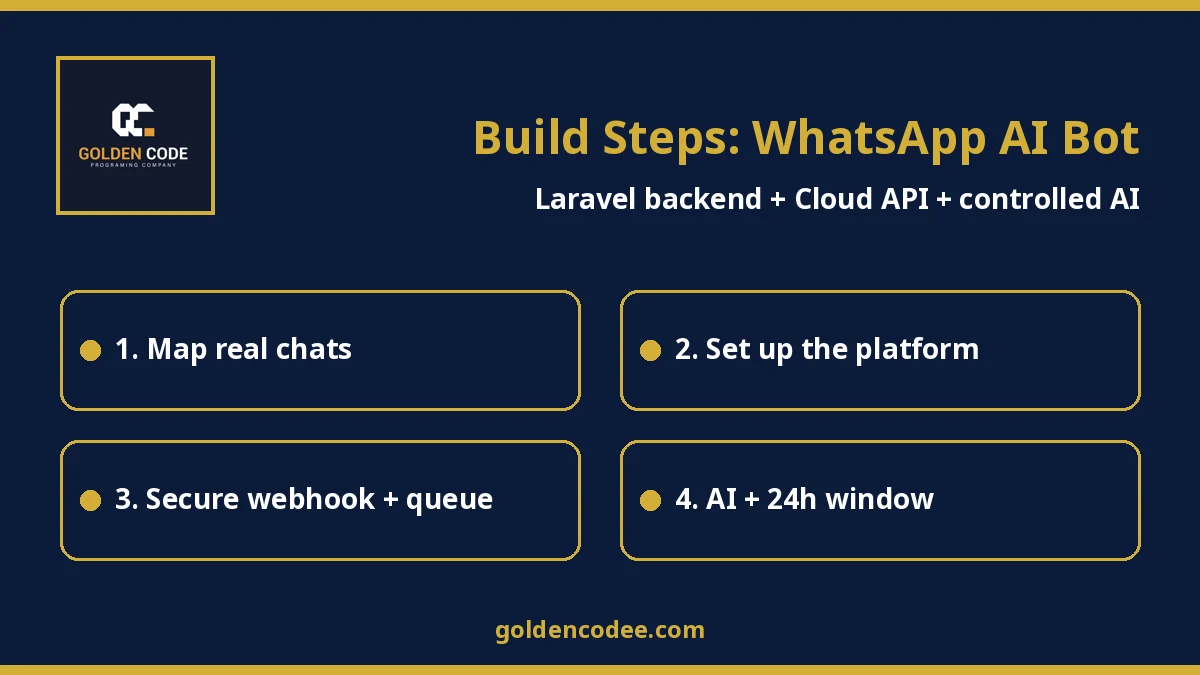
Step 1: Map the conversations
Before any code, we export a sample of real chats (with personal data removed) and group them: what do customers ask, in which dialect, at what time, and which questions lead to sales. This decides the scope more than any feature list.
Step 2: Set up the WhatsApp Business Platform properly
You need a Meta business portfolio, a WhatsApp Business Account and a phone number registered on the Cloud API. The number you register cannot be used at the same time in the normal WhatsApp app, so plan which number to use. Display name approval and business verification are handled with Meta; we prepare and guide, but approval is Meta's decision.
Step 3: Build the backend
I build this in Laravel. The core pieces:
- A webhook endpoint that receives messages and verifies Meta's signature (the
X-Hub-Signature-256header) before trusting anything. - A queue, so replies are processed in the background and the webhook answers quickly.
- Idempotency, because webhooks can arrive more than once; one customer message must never create two orders.
- Integrations with your systems: booking calendar, store, ERP or CRM, payment links.
Step 4: Add the AI layer carefully
The AI model gets a limited, controlled job: understand the customer's message and choose an action or a reply from your approved knowledge. Prices and availability come from your database, not from the model's imagination. We log every AI decision so you can review it.
Step 5: Design around the 24-hour window and templates
Meta's rules are simple once you see them. When a customer messages you, a 24-hour customer service window opens and resets with each new message from them. Inside that window you can reply freely. Outside it, you can only reach the customer with an approved template, and only if they opted in to hear from you. A well-designed bot answers fast inside the window and uses templates only where they add value (booking reminders, order updates).
Step 6: Test in both dialects, then launch gradually
We test with real phrasing: Egyptian Arabic, Gulf Arabic, English and the mixed "Franco" style. Then we launch on part of the traffic, read the logs for a week and adjust before turning it on fully.
What drives the cost
I will not quote a universal number, because there isn't an honest one. The cost has four separate parts:
| Part | What it depends on | Who you pay |
|---|---|---|
| Build (one-time) | Number of integrations, conversation flows, languages, admin dashboard, testing depth | The development team |
| WhatsApp messages (monthly) | Volume and category of messages, recipients' country codes, the 1,000 free service messages per number | Meta, at its published rates |
| AI model usage (monthly) | Model choice, message length, how much context the bot sends per reply | The AI provider |
| Hosting and maintenance | Server, monitoring, updates to flows and content | Your hosting provider / maintenance contract |
Two design choices make a real difference to the monthly bill since October 2026: keeping simple answers (hours, location) as plain logic instead of an AI call, and not sending templates the customer does not need. Both are decisions we make at the design stage, not after launch.
Data protection in Egypt and the Gulf
Customer chats contain personal data, so the bot has to respect local law. In Egypt that means the Personal Data Protection Law No. 151 of 2020, in Saudi Arabia the Personal Data Protection Law supervised by SDAIA, and in the UAE Federal Decree-Law No. 45 of 2021 on personal data protection. I am a developer, not a lawyer, so for your specific case talk to your legal advisor, but in practice we always:
- Store only what the business needs, and set retention periods.
- Keep API keys and tokens out of the code and rotate them.
- Restrict who on your team can read conversation logs.
- Tell customers clearly when they are talking to an automated assistant.
Common mistakes I see
- Letting the AI answer prices from memory instead of from the database.
- Registering the owner's personal number on the API and losing the normal app on it.
- No human hand-over, so angry customers get stuck in a loop.
- Ignoring the 24-hour window, then discovering messages fail outside it.
- Skipping webhook signature checks and idempotency.
FAQ
Is an AI chatbot on WhatsApp allowed after Meta's January 2026 rule?
Yes, for business customer service. The rule targets AI providers offering general-purpose assistants as the main product; Meta stated it does not affect businesses using AI to serve their own customers.
Do I pay Meta for every message?
Not every message. Since 1 October 2026 service messages are free for the first 1,000 per business phone number each month, then charged at Meta's published rates. Template messages are charged by category and country.
Can the bot understand Egyptian and Gulf Arabic?
Modern AI models handle both reasonably well, but quality depends on testing with your real customer messages and giving the bot clear fallback rules.
Can it connect to my existing system?
That is the main reason to build custom. If your system has an API or a database we can access securely, the bot can read and write to it.
Can I keep using the WhatsApp app on the same number?
A number registered on the Cloud API cannot be used in the regular WhatsApp or WhatsApp Business app at the same time, so choose the number carefully.
How long does it take?
It depends on integrations and approvals. Meta's business verification and template approvals are outside the developer's control, so build them into your timeline.
Sources
- Meta, WhatsApp Business Platform pricing and current pricing documentation
- WhatsApp Business, FAQ on pricing and service messages
- WhatsApp, Business Solution Terms (last modified 15 January 2026)
- TechCrunch, WhatsApp bars general-purpose chatbots
- WhatsApp, Business Policy
Thinking about a bot for your business?
If you want the bigger picture first, our article on AI solutions for business (Arabic) covers it. If you want a WhatsApp assistant that actually knows your prices, bookings and orders, and you want it built for your business rather than rented, we are happy to look at your current chats and tell you honestly whether a custom bot makes sense yet. You can reach the Golden Code team through the contact page, or see our web development services.
About the author: Mohamed Samy is a senior backend developer at Golden Code with 7 years of experience building custom Laravel and PHP systems and their integrations.