Blog details


What a custom AI agent for business can really do in Egypt and the Gulf: real use cases, limits, guardrails, data rules, running costs and build steps.
Short answer: An AI agent for business is software that reads a request, decides which steps to take, and then actually takes them inside your systems: it checks stock, books an appointment, drafts a quote or opens a ticket, instead of only answering in text. A custom-built agent connects to your own data and rules, and it is worth it when the task is frequent, has clear rules and touches more than one system. It is not worth it when a simple form, an automation or a well-written FAQ would do the job.
By Mohamed Samy, senior Laravel/PHP backend developer (7 years). Published: 25 October 2026. Last updated: 25 October 2026.
In the last few months, the phrase "AI agent" has started appearing in almost every conversation I have with business owners, from a clinic in Nasr City to a distribution company in Riyadh. Most of them have seen a demo where an agent "does everything", and they want to know two things: can it work with our systems, and is it worth the money?
This guide is my honest answer as a backend developer who builds the part nobody sees in the demo: the integrations, the permissions, the logs and the fallback when the AI is wrong. It is written for businesses in Egypt first, then Saudi Arabia, the UAE, Kuwait, Qatar, Bahrain and Oman. If you want the broader picture of how AI is changing business, start with our general guide to AI solutions (Arabic); this article goes deeper on agents specifically.
Is there real demand for AI agents in the region?
I do not publish search volumes I cannot verify, so here is what the public tools showed when I checked on 25 October 2026 (volumes: not available):
- Google autocomplete for "وكيل ذكاء اصطناعي" returns the same ten suggestions in Egypt, Saudi Arabia and the UAE, including "وكيل ذكاء اصطناعي واتساب", "انشاء وكيل ذكاء اصطناعي" and "افضل وكيل ذكاء اصطناعي". People are not only curious; they are asking how to build one and how to put it on WhatsApp.
- Google autocomplete for "ai agent for business" suggests "automation", "operations", "business development" and "business intelligence" across the same three markets.
- Google Trends (last 12 months, relative): in the UAE, "ai agent" averaged 60.5 against 34.3 for "website design" in the same comparison, so it is a mainstream search there. In Egypt and Saudi Arabia, the Arabic phrase is still very small next to the general term "ذكاء اصطناعي", which means most people there still search for AI in general and have not yet learned the word "agent".
My reading: the UAE is already searching for agents by name; Egypt and Saudi Arabia are searching for what agents do, using everyday words. That is why this article uses plain language and real examples.
Chatbot, automation or AI agent: what is the difference?
| Rule-based chatbot | Automation (workflows) | AI agent | |
|---|---|---|---|
| How it decides | Fixed menu and keywords | Fixed "if this, then that" rules | Understands the request and chooses steps |
| What it can do | Answer from a script | Move data between systems | Read data, call your systems, take actions, ask follow-up questions |
| Handles new wording | Poorly | Not at all | Well, within limits |
| Risk | Low | Low | Higher: it can be wrong, so it needs guardrails |
| Best for | Simple FAQs | Repetitive, identical tasks | Varied requests that still follow business rules |
Gartner warned in June 2025 that many vendors are doing "agent washing", meaning they rebrand ordinary chatbots and automation as agents, and that over 40% of agentic AI projects will be canceled by the end of 2027 because of cost, unclear value or weak risk controls (Gartner). I take that seriously. The answer is not to avoid agents; it is to pick the right task. If your task is really a fixed, repeated process, start with our guide to AI automation for business, which focuses on automating workflows.
Real use cases I would build in Egypt and the Gulf
These are the kinds of tasks where an agent makes sense, because the request varies but the rules are clear:
- Customer service with real data. The agent reads the order number from a WhatsApp message, checks the status in your system, and replies with the actual shipping state, then hands over to a person if the customer is angry or the case is unusual.
- Bookings for clinics, salons and service companies. It understands "Thursday evening, any doctor", checks availability, books, and sends a confirmation.
- Sales quotes. A B2B customer asks for a price on a mix of items; the agent pulls current prices and stock, builds a draft quote, and a salesperson approves it before it goes out.
- Internal assistant for staff. Employees ask in Arabic "how many returns did we have from Jeddah this week?" and the agent queries the database with read-only access.
- Lead qualification. It asks the right questions, records the answers in your CRM, and books a call with the right person.
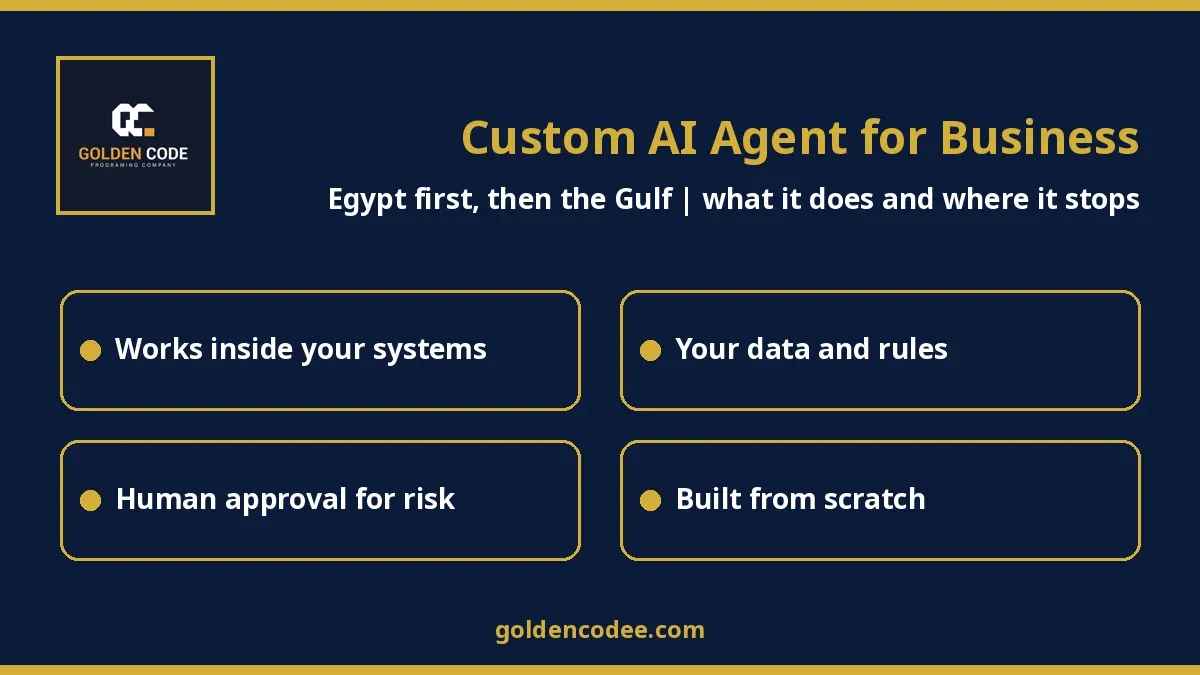
Notice the pattern: the agent works inside your systems, and a human approves anything risky. That is exactly why these are custom builds. A generic tool does not know your order statuses, your pricing rules or your approval chain.
What an AI agent should not do (yet)
- Make final financial or legal decisions without human approval.
- Work without logs. If you cannot see what it did and why, you cannot trust it.
- Get full write access to everything. Each tool it uses should have the smallest permission it needs.
- Replace a process you have not defined. If your team handles the task differently every time, an agent will copy the chaos.
How a custom AI agent is built
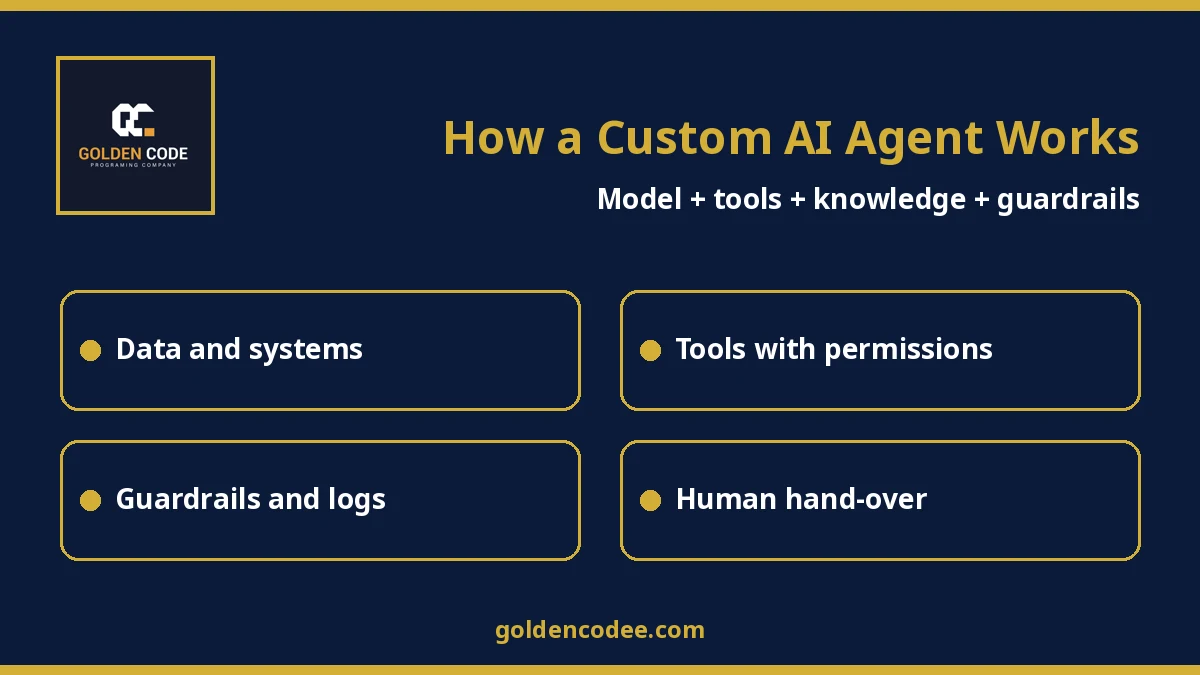
From the backend side, a business agent has four parts:
- The model: the language model that understands the request. We choose it per project based on Arabic quality, cost and where the data can be processed.
- Tools: small, well-defined functions the agent is allowed to call, such as "check order status" or "create booking". In our stack these are Laravel endpoints with validation.
- Knowledge: your policies, prices and FAQs, kept up to date and retrieved when needed, so the agent answers from your data instead of guessing.
- Guardrails: permissions, limits, approval steps, logging, and a clear hand-over to a human.
Step 1: Pick one task with clear value
Choose one frequent task, describe it in a page, and write down how you will measure success, such as time saved per request or fewer missed bookings.
Step 2: Map the data and systems involved
List every system the task touches (CRM, ERP, booking system, WhatsApp) and check that each one has an API or a safe way to connect.
Step 3: Define the tools and permissions
Turn each action into a small tool with strict inputs. Start with read-only access, then add actions that require approval.
Step 4: Build the guardrails and hand-over
Decide when the agent must stop and pass the case to a person, what it must never do, and where every decision is logged.
Step 5: Test with real conversations
Use real, anonymised requests from your team, in Egyptian and Gulf Arabic as well as English, and fix the failures before launch.
Step 6: Launch small and measure
Start with one channel or one team, review the logs weekly, and expand only when the numbers justify it.
Data, privacy and cost: the practical side
Data protection. Customer data in an agent is still personal data. Egypt has the Personal Data Protection Law No. 151 of 2020; Saudi Arabia's PDPL is overseen by SDAIA (SDAIA data protection portal); and the UAE has its federal data protection framework (u.ae overview). In practice, this means collecting only what the agent needs, controlling where the data is processed, and keeping access logs.
Running costs. An agent is not a one-time cost. Besides building it, you pay for model usage (usually per volume of text processed), hosting, and channel fees. If your agent works on WhatsApp, Meta's pricing for business messaging applies and was updated recently (Meta WhatsApp pricing). Ask any provider to estimate these monthly costs based on your expected volume before you start.
Build cost. I will not quote a number here, because it depends on how many systems the agent touches and how much it is allowed to do. A read-only agent answering from one database is a very different project from one that creates orders in your ERP. A serious provider should give you an itemised estimate after a short scoping session.
Questions to ask before you hire anyone
- Which exact task will the agent handle in the first version, and how will we measure it?
- Which systems will it connect to, and with what permissions?
- What happens when it is wrong or unsure?
- Where is our data processed and stored, and who can see the logs?
- What are the expected monthly running costs at our volume?
- Do we own the code and the prompts, and can we switch models later?
FAQ
What is an AI agent for business?
It is software that understands a request, decides which steps to take, and performs actions in your systems, such as checking an order or creating a booking, within permissions and rules you set.
Is an AI agent the same as a chatbot?
No. A chatbot mostly answers. An agent can also act: it calls your systems, collects missing information and completes tasks, which is why it needs stronger controls.
Can an AI agent work on WhatsApp in Arabic?
Yes. It can be connected through the official WhatsApp Business Platform and built to understand Egyptian and Gulf Arabic, with a hand-over to a person when needed. Meta's messaging fees apply.
Do I need a custom agent or a ready-made tool?
If the task only needs general answers, a ready-made tool may be enough. If it must use your own data, rules and systems, a custom build gives you control over integrations, permissions and data.
Is it safe to give an AI agent access to our data?
It can be, if access is limited to what each task needs, risky actions require human approval, and every action is logged. It also has to follow data protection law in your country.
How long does it take to build a first version?
It depends on the task and the systems involved. A focused first version on one task and one channel is the fastest route, and you expand after seeing real results.
Sources
- Gartner, "Gartner Predicts Over 40% of Agentic AI Projects Will Be Canceled by End of 2027", 25 June 2025: gartner.com
- Saudi Data and AI Authority, personal data protection portal: dgp.sdaia.gov.sa
- UAE Government portal, data protection laws: u.ae
- Meta, WhatsApp Business Platform pricing: developers.facebook.com
- Google autocomplete and Google Trends, checked 25 October 2026 (relative interest only; search volumes not available).
Thinking about an AI agent?
If you have a task that eats your team's time every day, send us a short description and we will tell you honestly whether an agent is the right tool, or whether something simpler would do. You can reach the Golden Code team through the contact page or see our development services.
About the author: Mohamed Samy is a senior backend developer at Golden Code with 7 years of experience building custom Laravel and PHP systems and connecting them to external services and AI models.