Blog details


Mobile app development cost in Egypt, Saudi Arabia, UAE, Kuwait, Qatar, Bahrain and Oman in 2026, from published agency prices, plus what moves the price.
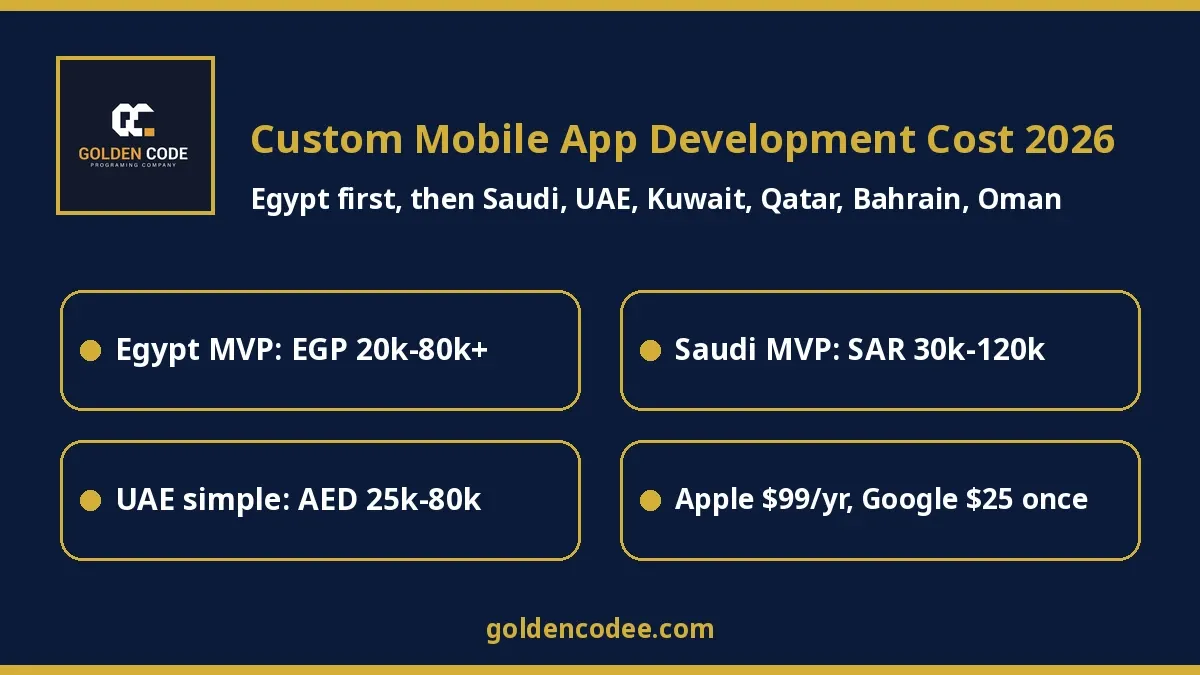
Short answer: In Egypt, agencies publish 2026 ranges that start at about EGP 20,000–80,000 for a very simple app or focused MVP. Practical apps with a backend and admin panel run EGP 150,000–400,000, and delivery or marketplace platforms go from EGP 400,000 to a million and more. In Saudi Arabia, published guides put a simple app or MVP at roughly SAR 30,000–120,000. In the UAE the range is about AED 25,000–80,000. Kuwait, Qatar, Bahrain and Oman agencies publish their own bands, listed below. On top of the build, Apple charges USD 99 a year and Google Play a one-time USD 25. The biggest cost driver is not the number of screens. It is the backend, the user roles and the integrations behind them.
By Mohamed Samy, senior Laravel/PHP backend developer (7 years). Published: 31 October 2026. Last updated: 31 October 2026.
When someone asks me "how much is an app?", I ask three questions back. Who uses it: only customers, or customers plus drivers, vendors or staff? Where does the data come from: does it already live in a system you run, or does everything start from zero? And how does money move: cash on delivery, a payment gateway, subscriptions? The answers usually move the price more than the design or the number of screens.
I build the backend side of apps: the API, the admin panel, the integrations and the server the app talks to. Our mobile team builds the app itself. This guide collects the 2026 prices that agencies in Egypt and each Gulf country publish on their own pages, explains what sits behind those numbers, and shows how to ask for a quote you can actually compare. Every figure below comes from a page I opened on 31 October 2026. The sources are listed at the end.
Do you need an app, or a website first?
Before talking prices, check whether an app is the right first step. If people find you through Google and buy once, a fast website usually comes first. My custom website design cost guide covers that. If you mainly sell products online, start with the custom ecommerce store cost guide. An app makes sense when people come back often: ordering every week, booking regularly, tracking a delivery, using a loyalty wallet, or when staff and drivers need a tool in their pocket. Many projects end up with both, sharing one backend, which is the cheapest way to do it.
Egypt: published 2026 app prices
Egyptian agencies publish wide ranges, and the gap between them is mostly about what "app" includes.
| Source (Egypt) | Simple / MVP | Mid-level | Large / platform |
|---|---|---|---|
| 2B Online | EGP 20,000–50,000 (very simple); EGP 50,000–150,000 (practical MVP) | EGP 150,000–400,000 | EGP 400,000 to 1 million+ |
| Webdivs | EGP 50,000–110,000 | EGP 90,000–220,000 (ecommerce or delivery) | EGP 180,000–400,000+ (on-demand platform) |
| Enum Grow | EGP 30,000–80,000 (focused React Native MVP) | — | — |
Two things stand out. First, the bottom of every range is a small app: few screens, little or no backend, no payments. Second, the jump to the next band usually comes from the backend and admin panel, not the screens. 2B Online states it plainly: one screen tied to an algorithm, payments or maps can cost more than several static information screens.
The Gulf: published 2026 app prices by country
Gulf prices are listed in local currency, as each source publishes them. Amwaj Solutions gives its Saudi ranges before 15% VAT, and TekRevol's Bahrain guide tells readers to add 10% VAT. Always ask whether a quote includes VAT.
| Country | Source | Simple / MVP | Mid-level | Large |
|---|---|---|---|---|
| Saudi Arabia | Amwaj Solutions | SAR 30,000–100,000 | SAR 70,000–300,000 | SAR 250,000–1,000,000+ |
| Saudi Arabia | Vrinsofts | SAR 45,000–120,000 | SAR 150,000–450,000 | SAR 400,000–800,000 (customer-facing, e.g. delivery) |
| Saudi Arabia | Symloop packages | SAR 55,000 | SAR 150,000 | Custom quote |
| UAE | NomadX | AED 25,000–80,000 | AED 90,000–300,000 | AED 300,000–1,000,000+ |
| UAE | GoodFirms | AED 30K–80K+ | AED 80K–200K+ | AED 200K–400K+ |
| Kuwait | Web Pioneer | KWD 900–1,400 | KWD 1,400–2,450 | From KWD 2,450 |
| Kuwait | TechLabs | iOS + Android from KWD 1,250 | Ordering or marketplace from KWD 1,750 | — |
| Qatar | TekRevol | QAR 20,000–70,000 | QAR 75,000–150,000 | QAR 350,000+ (enterprise) |
| Qatar | Noxira | From QAR 45,000 (one platform) | From QAR 80,000 (both stores) | Retainer |
| Bahrain | TekRevol | BHD 1,800–5,000 | — | Up to about BHD 35,000 |
| Bahrain | WisdomDigi | From BHD 1,500 | From BHD 3,500 | Custom quote |
| Oman | Apptunix | OMR 4,600–15,000 | OMR 15,000–35,000 | Above that |
Even inside one country, sources disagree by a factor of two or three. Amwaj Solutions says this openly: the Saudi guides it reviewed "overlap and disagree, sometimes widely." That is why I do not trust a single number. Read what each band includes, then compare it to your own scope.
What actually moves the price
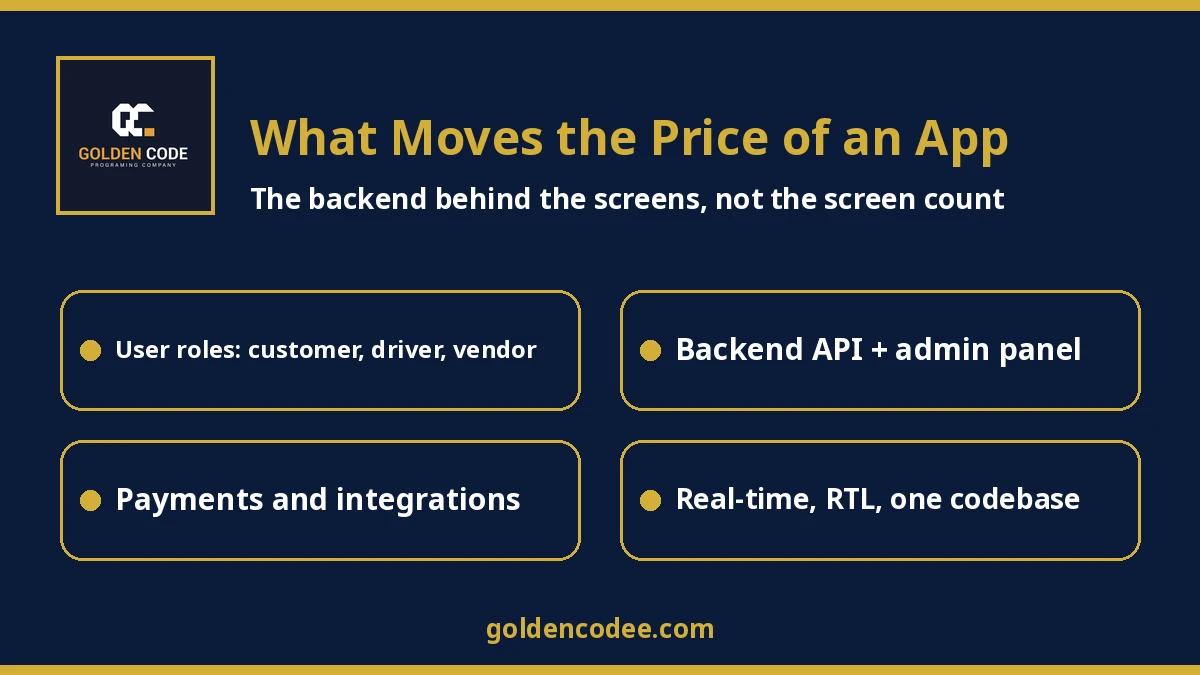
From the backend side, these are the items that change a quote the most:
- User roles. One customer app is one product. Customer plus driver plus vendor plus operations staff is three or four products sharing a backend. Every delivery or ride app in the tables above sits in the top band for this reason.
- Backend and admin panel. Login, data, notifications, permissions, reports and the panel your team uses every day. This is often the largest single part of a real app, and it is where cheap quotes cut corners.
- Payments. Card gateways in Egypt, mada and Apple Pay in Saudi Arabia, KNET in Kuwait, BenefitPay in Bahrain. Each needs webhooks, refunds and reconciliation, not just a button. For the details, see our payment gateway integration guide (Arabic).
- Integrations with what you already run. An existing ERP, POS, CRM, WhatsApp or e-invoicing. In Saudi Arabia, for example, invoices issued from an app may need to go through ZATCA. See my ZATCA Phase 2 integration guide.
- Real-time features. Live tracking, chat and dispatch need different server work than a normal list screen.
- Arabic and English with RTL. It is cheaper to plan both from day one than to retrofit Arabic later.
- One codebase or two. Cross-platform frameworks such as Flutter or React Native build iOS and Android from one codebase. Amwaj Solutions and Webdivs estimate the saving at 25–40%, and NomadX at roughly 20–40%, compared with two native apps. Native still has its place for heavy device features.
Running costs nobody puts in the first quote
The build price is not the full bill. Plan for:
- Store accounts: the Apple Developer Program is USD 99 per membership year, and Google Play has a USD 25 one-time registration fee. Open both in your company's name, not the developer's.
- Hosting and services: servers, database, file storage, SMS for OTP codes, maps, and push notifications once you pass free tiers.
- Maintenance: Apple and Google change their requirements regularly, so apps need updates even when you add nothing new. Amwaj Solutions' Saudi guide suggests budgeting roughly 15–20% of the build cost a year and calls it an industry rule of thumb. Treat it as a planning number, not a quote.
Ready-made app or custom?
Some platforms, such as Salla for stores, or app-builder tools can give you a store app quickly. That can be fine if you run a standard store and want to start fast. A ready-made option starts to struggle when you have drivers with their own app, special pricing logic, an existing system to connect, or data you need to fully own. That is where a custom app usually pays off over time, because you are not paying a subscription for every feature or working around the platform's limits.
Mistakes I see when companies buy an app
- Buying the app without the backend. A quote that shows only screens often leaves out the API, admin panel and hosting. Then the second invoice arrives.
- Starting with every feature. Start with the one journey that earns money, then add.
- Not owning the accounts and code. Store accounts, server, domain and source code should be in your company's name.
- Rebuilding data you already have. If customers, products or stock already live in a system, the app should read from it through an API, not copy it by hand.
- No plan for updates. An app that is not maintained can fall behind new Apple and Google requirements.
How to get a mobile app quote you can compare in 6 steps
Step 1: Write the one journey that matters
Describe the main thing a user does, from opening the app to paying or booking. Keep it to one page. This is your MVP.
Step 2: List every user type
Customer, driver, vendor, branch staff, admin. For each one, write what they can see and do. Every extra role adds screens, permissions and testing.
Step 3: List integrations and payments
Payment gateway, maps, SMS, WhatsApp, and any system you already run, such as an ERP, POS or e-invoicing. Mark which ones are needed at launch.
Step 4: Decide platforms and languages
iOS, Android or both; Arabic, English or both with RTL. Ask whether the team proposes one codebase or two native apps, and why.
Step 5: Ask for an itemised quote
Ask for separate lines for design, app, backend API, admin panel, integrations, testing, store publishing and the first months of support. Compare line by line, not just the total.
Step 6: Secure ownership and running costs
Confirm that source code, store accounts and servers are in your company's name. Ask for a written estimate of monthly running costs and a maintenance plan.
FAQ
How much does it cost to build an app in Egypt in 2026?
Published Egyptian ranges start at about EGP 20,000–80,000 for a very simple app or focused MVP. Practical apps with a backend and admin panel run about EGP 150,000–400,000, and delivery or marketplace platforms reach EGP 400,000 to a million or more.
How much does app development cost in Saudi Arabia?
Saudi guides published in 2026 put a simple app or MVP at roughly SAR 30,000–120,000 and mid-level apps between SAR 70,000 and 450,000, depending on the source. Prices usually exclude 15% VAT.
How much does an app cost in Dubai or the UAE?
UAE guides publish about AED 25,000–80,000 for a simple app, AED 80,000–300,000 for mid-level apps, and AED 300,000 to 1,000,000+ for complex or regulated apps.
Is Flutter cheaper than native apps?
Usually, because one codebase serves iOS and Android. Several published guides say cross-platform lowers cost compared with two native apps. Native can still be the better choice for heavy device features.
What are the yearly costs after launch?
Apple charges USD 99 a year and Google Play a one-time USD 25. Add hosting, SMS, maps and other services, plus maintenance. One Saudi guide suggests about 15–20% of the build cost a year as a rule of thumb.
Can the app connect to my existing system?
Yes. A custom backend can expose your existing ERP, POS or CRM data to the app through an API, so you do not rebuild data you already have.
Sources
- Egypt: 2B Online, Webdivs, Enum Grow
- Saudi Arabia: Amwaj Solutions, Vrinsofts, Symloop
- UAE: NomadX, GoodFirms
- Kuwait: Web Pioneer, TechLabs
- Qatar: TekRevol, Noxira
- Bahrain: TekRevol, WisdomDigi
- Oman: Apptunix
- Store fees: Apple Developer Program, Google Play Console
All prices were read on these pages on 31 October 2026 and may change. They are each agency's own published ranges, not quotes.
Planning an app?
Send us a short description of the main journey, the user types, and any system the app should connect to. We will tell you honestly whether you need an app, a website, or both, and what to build first. Everything we build is custom. For the backend, our proposed Mobile App API Backend package starts at 54,000 EGP. It includes a Laravel REST API with OTP or email login (up to 25 endpoints), a basic admin panel, push notifications, Postman/Swagger documentation and deployment. The app itself, built with Flutter or React Native, is quoted separately by our mobile team, and the final price is confirmed after scoping. You can reach the Golden Code team through our contact page.
About the author: Mohamed Samy is a senior backend developer at Golden Code with 7 years of experience building custom Laravel and PHP business systems, integrations and automation for companies in Egypt and the Gulf.