Blog details


UAE e-invoicing deadlines, the new penalties and the 5-corner model, plus how to connect a custom ERP, POS or billing system to your ASP in 6 steps.
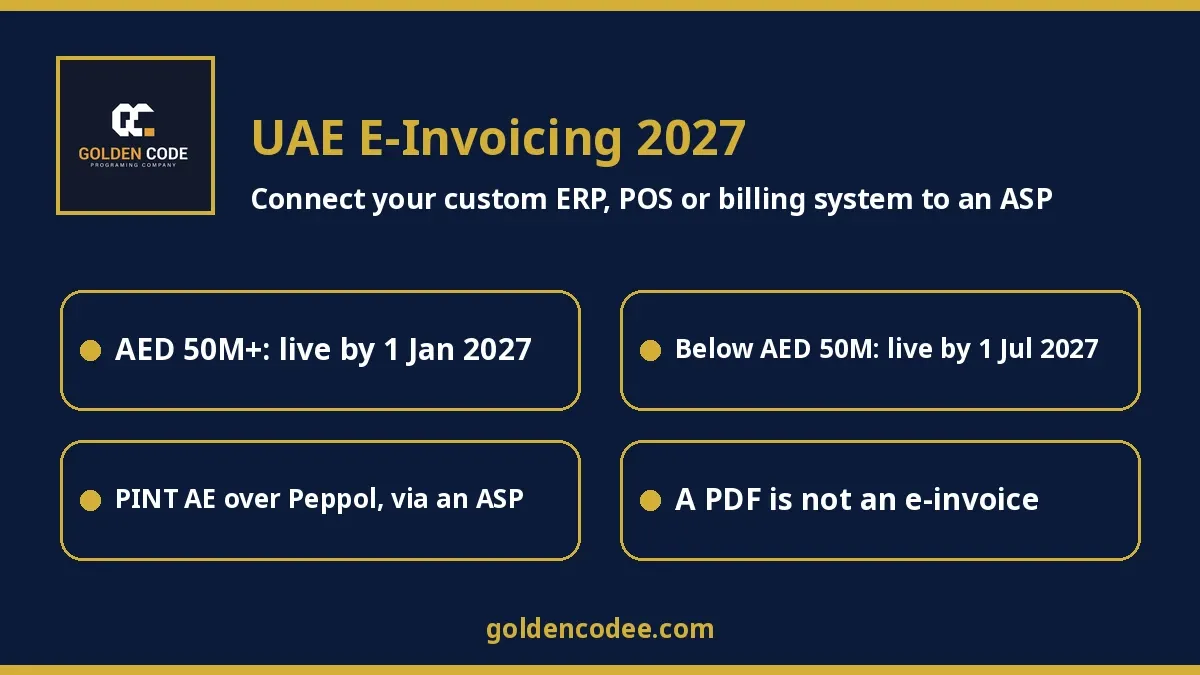
Short answer: UAE e-invoicing becomes mandatory on 1 January 2027 for businesses with annual revenue of AED 50 million or more. Their deadline to appoint an Accredited Service Provider (ASP) was 30 October 2026, extended from 31 July. Businesses below AED 50 million must appoint an ASP by 31 March 2027 and go live on 1 July 2027. Government entities go live on 1 October 2027. Invoices are exchanged as structured PINT AE files over the Peppol network through your ASP, and a PDF is no longer an e-invoice. If your invoices come from a system built for your business, the real work is getting clean data out of it and into your ASP's API.
By Mohamed Samy, senior Laravel/PHP backend developer (7 years). Published: 1 November 2026. Last updated: 1 November 2026.
Two things happened in the last week of October. On 25 October, the Federal Tax Authority (FTA) reminded businesses with revenue of AED 50 million or more to appoint an ASP by 30 October 2026. On 30 October, the Ministry of Finance (MoF) announced a new Cabinet Decision on e-invoicing penalties. Searches for "e invoicing" in the UAE also rose sharply in late October and early November, according to Google Trends.
I build and integrate business systems in Laravel and PHP, for companies in Egypt and the Gulf. Many companies run a custom ERP, a POS, a booking platform or a B2B portal instead of SAP or Odoo. For those companies, choosing an ASP is the easy part. The hard part is making sure every invoice and credit note that leaves their system arrives at the ASP complete, correct and on time, with the response written back. This guide explains what the rules say, from the official MoF and FTA sources, and how I would approach the integration. It is not tax advice; confirm your obligations with your tax advisor.
The UAE e-invoicing timeline
| Who | Appoint an ASP by | Go live by |
|---|---|---|
| Businesses with revenue of AED 50 million or more | 30 October 2026 (extended from 31 July 2026) | 1 January 2027 |
| Businesses with revenue below AED 50 million | 31 March 2027 | 1 July 2027 |
| Government entities | 31 March 2027 | 1 October 2027 |
Sources: Ministerial Decision No. 244 of 2025, the MoF amendment announcement and the FTA reminder of 25 October 2026. The MoF stressed that the 1 January 2027 go-live date "will remain unchanged". Voluntary implementation has been possible since 1 July 2026.
A few scope points from the same decisions and the MoF e-invoicing guidelines:
- B2B and B2G are in scope. Business-to-consumer transactions are not subject to the system, and a business that deals only with consumers is out, until the Minister decides otherwise.
- Both sides need an ASP. The MoF says issuers and recipients of invoices are required to appoint an ASP. So even if you mostly buy, you still need to receive e-invoices through one.
- Credit notes count too. An electronic credit note is required when a transaction is cancelled, the price is reduced, a refund is made, or an error is corrected.
- VAT registration is not the test. The guidelines say e-invoicing applies to any person doing business in the UAE regardless of VAT registration status, unless specifically excluded.
What changed on 30 October: the new penalty decision
The MoF announcement carried by WAM says a new Cabinet Decision replaces Cabinet Decision No. 106 of 2025. For failing to implement the system, including failing to appoint an ASP, the penalty is AED 5,000 for the initial violation, then AED 5,000 for each month or part of a month that it continues, up to AED 50,000 in any twelve consecutive months. A person acting as both issuer and recipient for the same violation gets only one penalty.
Sovos identifies it as Cabinet Decision No. 173 of 2026, in force the day after publication in the Official Gazette. It also lists AED 100 per e-invoice or credit note not issued and transmitted on time, capped at AED 5,000 per calendar month, and AED 250 per day, capped at AED 5,000 a month, for not telling your ASP about changes to your registered data.
If you are in the first group and have not appointed an ASP yet, the deadline has passed. Speak to your tax advisor, appoint one now, and focus on being live by 1 January 2027.
How UAE e-invoicing works: the 5-corner model
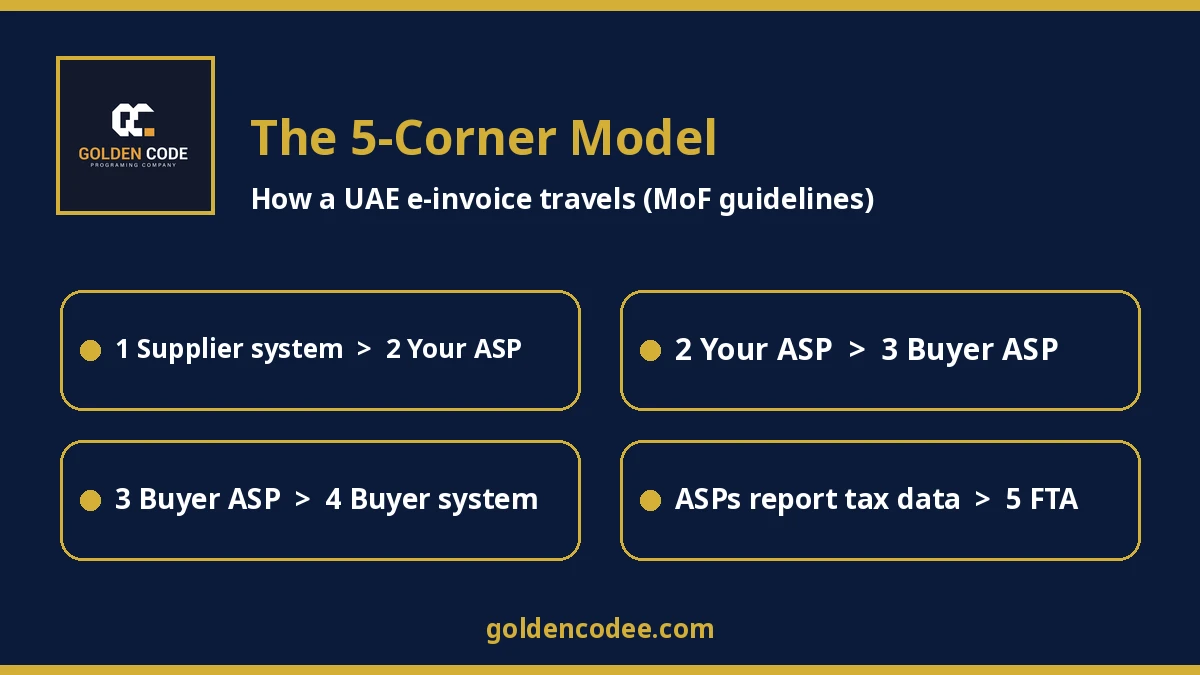
The MoF guidelines describe a "5 Corner model":
- Corner 1, the supplier: your system creates the invoice and sends its data to your ASP in an agreed format.
- Corner 2, your ASP: validates the data, converts it to the UAE standard XML (PINT AE) and sends it to the buyer's ASP. In parallel, it reports tax data to the FTA.
- Corner 3, the buyer's ASP: validates the invoice, confirms back to Corner 2, and reports tax data to the FTA.
- Corner 4, the buyer: receives the invoice in their own system.
- Corner 5, the FTA: receives the tax data and sends confirmations, which flow back to you through your ASP.
The network is Peppol, and the invoice format is Peppol's PINT AE billing specification. On the MoF's e-invoicing page, it says plainly that PDF files, Word documents, images, scans and emails are not e-invoices.
Some details matter for your data:
- Your participant ID is your TIN, which the guidelines define as the first 10 digits of your TRN. In a tax group, it is your own TRN's first 10 digits, not the group representative's.
- When a buyer is not on the system yet, the supplier must use a predefined endpoint on the e-invoice, and a regular tax invoice (for example a PDF) is still needed in addition.
- You cannot add your own optional fields to PINT AE. Industry-specific needs are discussed with your ASP.
- Retention: invoice data must be kept, generally for 5 years after the tax period for taxable persons, and longer in some cases, in a way the FTA can retrieve.
Choosing an ASP is a business decision; the connection is the technical work
The MoF's list of accredited providers had 83 entries when I checked it on 1 November 2026, including global firms and local software companies. The MoF also publishes a guide on considerations for selecting an ASP. ASP pricing varies; for example, the accredited provider Wafeq advertises live plans starting from AED 89 per taxpayer per month.
Once you have an ASP, there are three common ways to connect, as integration guides such as ClearTax's describe:
- A ready connector. If you run a standard platform, your ASP or a marketplace may already offer one. Odoo, for example, has third-party PINT AE connector modules. This is the fastest route when your setup is standard.
- Direct API integration. Your own system sends invoice data to the ASP's API and stores the response. This suits a single custom system.
- Middleware. A separate service collects invoices from several sources, such as ERP, POS and an online store, validates and maps them, then sends them to the ASP. This suits companies with more than one invoicing system, and it makes it easier to switch ASP later.
For custom systems there is usually no ready connector, and that is where a custom integration makes sense. I would build it as a module inside your existing system, or as a small service beside it, rather than replacing a system your team already knows.
What I check first in a custom system
From the backend side, these are the gaps I usually find:
- Missing buyer data. No TRN or Peppol ID stored for business customers, or stored in free-text notes.
- Tax treatment per line. Standard, zero-rated and exempt items mixed without a clear tax category on each line.
- Credit notes that are not real documents. Refunds or discounts edited directly on the original invoice instead of issued as credit notes.
- More than one invoicing source. An ERP plus a POS plus a booking or ecommerce system, each numbering invoices its own way.
- Nobody owns rejections. If the ASP rejects an invoice, someone has to see it the same day, fix the data and resend.
- Receiving, not just sending. Supplier e-invoices should land in purchases or accounts payable instead of being typed in again.
If you also sell in Saudi Arabia, the same system may already need ZATCA integration; see my ZATCA Phase 2 integration guide. The UAE model is different (Peppol through an ASP), so plan a shared invoice core with a separate adapter for each country. If your system itself is the problem, my custom ERP guide covers when to rebuild and when to integrate.
How to prepare your custom system for UAE e-invoicing in 6 steps
Step 1: Confirm your phase and scope
Check your revenue band, your deadlines, and which transactions are B2B or B2G. Confirm exclusions with your tax advisor. Remember that you also need an ASP to receive invoices.
Step 2: Map every system that issues invoices or credit notes
List the ERP, POS, ecommerce, booking or billing systems, and the documents each one produces. Note who owns each system and how it numbers documents.
Step 3: Run a data gap check against the mandatory fields
Compare what your system stores with the MoF's mandatory field list and PINT AE. Fix buyer TRNs and TINs, tax categories, units, currencies and credit note logic before you write any integration code.
Step 4: Appoint an ASP and get its API and sandbox
Sign with an accredited ASP, complete the onboarding on EmaraTax, and get your Peppol participant identifier. Ask for API documentation, a test environment and the rejection codes.
Step 5: Build the connection with status write-back
Send each invoice and credit note to the ASP automatically when it is posted. Store the ASP's status, IDs and any rejection reason on the invoice, retry safely on failures, and alert someone when an invoice is rejected. Pull incoming supplier e-invoices into your system.
Step 6: Test real scenarios end to end, then go live
Test credit notes, discounts, zero-rated and exempt lines, buyers not yet on the system, and multi-currency invoices with the ASP. Reconcile what was sent against your books before go-live, then monitor daily for the first weeks.
FAQ
When does UAE e-invoicing start?
Mandatory implementation starts on 1 January 2027 for businesses with revenue of AED 50 million or more, on 1 July 2027 for those below, and on 1 October 2027 for government entities. Voluntary implementation has been possible since 1 July 2026.
What was the ASP appointment deadline?
For businesses with revenue of AED 50 million or more, it was 30 October 2026, extended from 31 July 2026. For businesses below AED 50 million and government entities, it is 31 March 2027.
What are the UAE e-invoicing penalties?
Under the new Cabinet Decision announced on 30 October 2026, failing to implement the system or appoint an ASP costs AED 5,000 initially and AED 5,000 per month it continues, up to AED 50,000 in twelve months. Sovos lists AED 100 per e-invoice or credit note not sent on time, capped at AED 5,000 a month.
Is a PDF invoice still valid?
Not as an e-invoice. The MoF says PDFs, Word files, images, scans and emails are not e-invoices. A regular tax invoice is still needed alongside the e-invoice when the buyer is not yet on the system.
Do I need to replace my ERP?
Usually not. Most ASPs accept data through an API, and a custom system can be connected through a module or middleware. Replacement only makes sense if the system cannot produce reliable invoice data.
Does e-invoicing apply to B2C sales?
Not for now. Ministerial Decision No. 244 of 2025 says business-to-consumer transactions are not subject to the system until the Minister decides otherwise.
Sources
- Ministerial Decision No. 244 of 2025 on the implementation of the e-invoicing system (FTA)
- MoF: scope and timelines decisions
- MoF: ASP deadline extended to 30 October 2026
- FTA reminder, 25 October 2026
- WAM: MoF announces updated e-invoicing penalties, 30 October 2026
- Sovos: Cabinet Decision No. 173 of 2026
- MoF UAE Electronic Invoicing Guidelines v1.0
- MoF e-invoicing page and list of accredited service providers
- Deloitte: ASP deadline extended, go-live remains 1 January 2027
- ClearTax: API, middleware and ERP integration, Wafeq, Odoo Apps: UAE FTA e-invoicing connector
All sources were read on 1 November 2026. Rules can change, so always check the latest MoF and FTA guidance.
Need your own system connected to your ASP?
If your invoices come from a system built for your business, send us a short description: which systems issue invoices and credit notes, roughly how many per month, which ASP you chose or are considering, and whether you also invoice in Saudi Arabia. We will tell you honestly whether a ready connector is enough or a custom integration makes more sense. We build the integration as a custom module or service around your existing system, working alongside your ASP and tax advisor; we are not an ASP. We will send a quote after we review your system. You can reach the Golden Code team through our contact page.
About the author: Mohamed Samy is a senior backend developer at Golden Code with 7 years of experience building custom Laravel and PHP business systems, integrations and automation for companies in Egypt and the Gulf.