Blog details


Custom ERP software development in Egypt, Saudi Arabia and the UAE: published 2026 price ranges, custom vs Odoo or SAP, e-invoicing and a quote checklist.
Short answer: A custom ERP is a system built around how your company actually works. It covers sales, purchasing, stock, accounting, HR, approvals and reporting, with no per-user licence and with source code you own. In Egypt, published prices for custom ERP start in the tens of thousands of pounds for a small core system and reach well into six or seven figures for multi-branch or manufacturing builds. Saudi and UAE agencies publish ranges in the low hundreds of thousands of riyals or dirhams and up. A ready ERP like Odoo or SAP is often the better start when your processes are standard. Custom pays off when your process is your advantage, when integrations are heavy, or when per-user licences add up.
By Mohamed Samy, senior Laravel/PHP backend developer (7 years). Published: 29 October 2026. Last updated: 29 October 2026.
Most ERP conversations I have start the same way. A company has grown from one branch to three, and stock lives in Excel. Accounting re-types invoices from the sales system, and the owner gets numbers a week late. Somebody has already tried a ready ERP, and either the team refused to use it or half the real process ended up back in Excel. The question is rarely "do we need an ERP?" It is "do we need our ERP, or can we bend to a standard one?"
This guide is for companies in Egypt first, then Saudi Arabia, the UAE, Kuwait, Qatar, Bahrain and Oman. Golden Code only builds custom systems from scratch; we do not sell or resell Odoo, SAP or any other ready ERP. I mention them here as an honest comparison, because for some companies they are the right answer.
What people in the region are searching for
Google's suggestions show what buyers want. In Egypt and Saudi Arabia, "برنامج erp" (ERP software) expands to accounting ERP, ERP for warehouses, for contractors and for factories, plus free and open-source options. People also look up "best ERP software in Egypt" and "in Saudi Arabia". In English, "custom erp" expands to custom ERP software development, services and companies. "erp software" expands to "uae", "dubai" and "in saudi arabia", and "erp system cost" to "for small business" and "per month".
In Google Trends over the last 12 months, "odoo" is by far the strongest ERP-related term in Egypt, Saudi Arabia and the UAE. That tells me most buyers start by evaluating a ready product, so a custom build has to justify itself against it. Exact search volumes are not available to us, and Search Console shows no ERP queries for our site yet.
What agencies publish for custom ERP in 2026
I do not invent prices. These are ranges agencies publish on their own pages, read on 29 October 2026. Each company defines "module" and "system" differently, so treat them as market signals, not quotes.
| Market | Published custom ERP range | Source |
|---|---|---|
| Egypt | Basic (stock, sales, simple accounting, one branch): EGP 80,000–180,000; mid (purchasing, HR, multi-branch): EGP 200,000–450,000; advanced (manufacturing, integrations, mobile): from EGP 500,000 | Codeksoft (Arabic) |
| Egypt | Core system, 2–3 modules: from EGP 165,000; full multi-module: EGP 250,000–440,000; large integrated: from EGP 440,000 | Web Pioneer |
| Egypt | Small/MVP, 2–3 modules: EGP 400,000–1,500,000; mid-size, 5–8 modules: EGP 1,500,000–6,000,000; plus EGP 30,000–80,000 for ETA e-invoicing | Buildn Tech |
| Saudi Arabia | Core finance and inventory: SAR 130,000–225,000; full ERP with 3–5 integrations: SAR 560,000–1,120,000 | GO-Globe |
| UAE | Focused (inventory, sales, invoicing): AED 80,000–200,000; mid-size: AED 200,000–600,000; large: AED 600,000–1,500,000+ | Joyboy |
| UAE | Full custom ERP: AED 60,000–400,000; single module rollout from AED 25,000 | Control Shift |
I did not find published ranges at the same level for Kuwait, Qatar, Bahrain or Oman, so I will not state any. The Egyptian ranges alone differ by roughly ten times for "a small system". That is the clearest sign that scope, not the word "ERP", sets the price.
Custom ERP vs Odoo, SAP and other ready ERPs
| Ready ERP (Odoo, SAP Business One, ERPNext) | Custom ERP built from scratch | |
|---|---|---|
| Start-up cost | Lower for standard setups; implementation and customisation are extra | Higher one-time build |
| Running cost | Per-user subscription or licence (see Odoo pricing), plus partner support | Hosting and maintenance; one UAE guide estimates maintenance at about 15–20% of the build price per year (Joyboy) |
| Fit to your process | You adapt to the product | The system follows your process |
| Users | Cost grows with each user | No per-user fee |
| Integrations | Available apps and connectors | Built directly to your systems |
| Ownership | Licence; data exportable | You own the code and database |
| Best for | Standard trading, services, under-customised processes | Unusual workflows, heavy integration, many users, or a process that is your edge |
My honest rule: if a ready ERP covers 80% of your process out of the box and your team can live with its way of doing the rest, start there. Go custom when the 20% it cannot do is exactly where you make or lose money, such as job costing for contractors, a factory's production stages, or a distributor's pricing and route sales.
Signs a custom ERP makes sense
- Your process does not fit the template. Contracting with progress billing and retention, manufacturing with custom stages, or rental and maintenance businesses.
- You fight customisation fees. Each change in the ready ERP needs a partner and a quote, and upgrades break your customisations.
- Users are many, and most only need one screen. Drivers, storekeepers or branch staff who should not cost a full licence each.
- Integrations are the core. Your ecommerce store, delivery apps, payment gateways, banks, POS and e-invoicing all have to talk to one database.
- Local compliance is central. Egyptian e-invoicing and e-receipts from the Egyptian Tax Authority, or ZATCA e-invoicing in Saudi Arabia, need to be built into the invoicing flow, not bolted on. If you are in Saudi Arabia's Wave 25, my guide to ZATCA Phase 2 integration explains how to connect an existing system to Fatoora before 1 February 2027.
How I would scope a custom ERP: start small
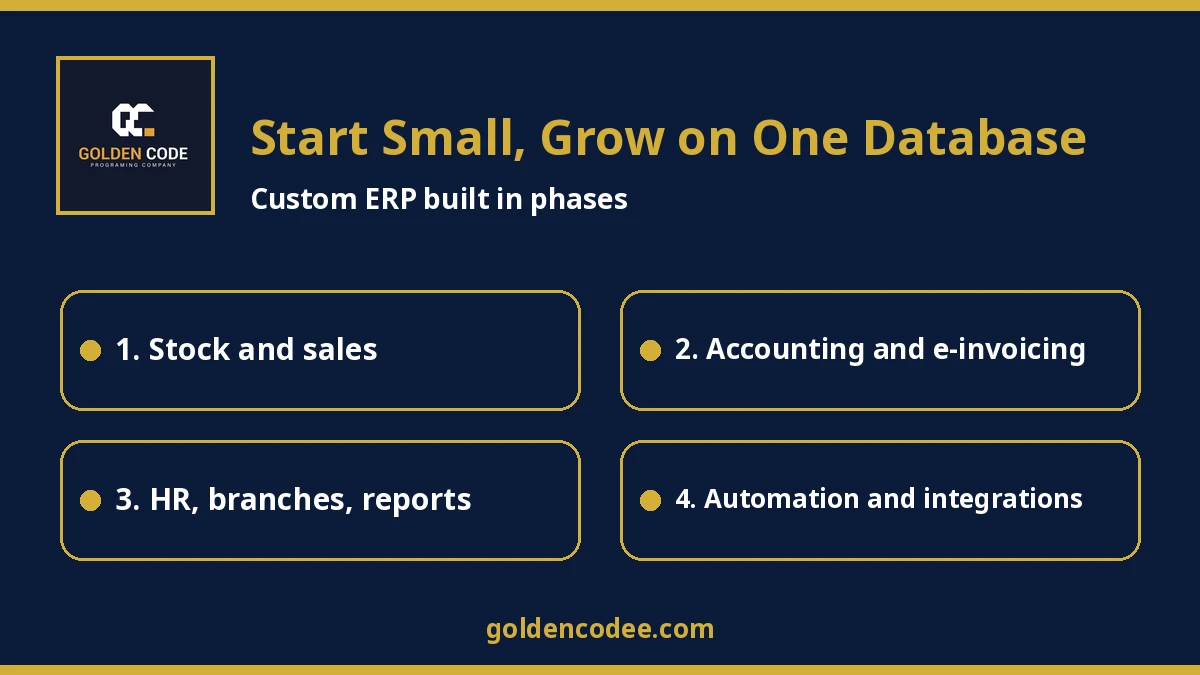
The ERP projects that fail are usually the ones that try to launch everything at once. I build in phases, on one database designed for growth:
- Phase 1: the module that hurts most. Usually stock and sales, or purchasing and approvals. It goes live in weeks, not a year.
- Phase 2: accounting and e-invoicing. Invoices flow from sales to accounting and to the tax authority automatically.
- Phase 3: HR, branches and reporting. Permissions per branch and role, and dashboards the owner actually opens.
- Phase 4: automation and integrations. Approvals, reminders and document reading. Our guide to AI automation for business covers this layer in detail.
If you sell online, the store and the ERP should share stock and orders. See our custom ecommerce website cost guide for that side. Payment gateways connect the same way as described in our payment gateway integration guide (Arabic).
How to get an ERP quote you can compare
Step 1: Map how work actually flows today
Follow one order from enquiry to cash, and one purchase from request to payment. Note every sheet, system and person it touches.
Step 2: List modules, users and roles
Write the modules you need, how many people use each, and what each role may see or approve.
Step 3: List every integration and compliance need
Accounting, banks, payment gateways, ecommerce, POS, delivery apps, and e-invoicing for Egypt or Saudi Arabia.
Step 4: Pick phase one
Choose the one or two modules with the most pain and the clearest rules, and agree on what "live" means for them.
Step 5: Ask for an itemised, phased quote
Request prices per phase and per integration, data migration and training listed separately, and the yearly running cost.
Step 6: Secure ownership and support
Make sure the source code, database, hosting account and documentation are yours, and agree on support and a change-request process.
FAQ
How much does a custom ERP cost in Egypt in 2026?
Published Egyptian ranges start around EGP 80,000–180,000 for a basic one-branch system at one agency and from EGP 165,000 at another. Multi-module systems run from a few hundred thousand pounds, and other agencies quote EGP 400,000 and up for small builds. Scope sets the price.
How much does ERP cost in Saudi Arabia or the UAE?
One Saudi agency publishes SAR 130,000–225,000 for core finance and inventory. UAE guides publish AED 80,000–200,000 for a focused system and AED 60,000–400,000 for a full custom build, depending on the agency.
Is Odoo cheaper than a custom ERP?
Usually at the start. Over several years, per-user subscriptions, partner fees and customisation can change that. Compare the total cost over three to five years for your real user count.
Can a custom ERP handle e-invoicing in Egypt and Saudi Arabia?
Yes. A custom ERP can integrate directly with the Egyptian Tax Authority's e-invoicing and with ZATCA in Saudi Arabia, as part of the invoicing flow.
How long does it take to build a custom ERP?
Published timelines range from about two months for a basic system to a year or more for large ones. Phased delivery puts the first module live much sooner.
Can we start with one module and grow?
Yes, and I recommend it. Build the first module on a database designed for the full system, then add modules without rebuilding.
Sources
- Egypt: Codeksoft, Web Pioneer, Buildn Tech, Egyptian Tax Authority
- Saudi Arabia: GO-Globe, ZATCA e-invoicing
- UAE: Joyboy, Control Shift
- Ready ERP pricing page: Odoo
All agency figures were read on their own pages on 29 October 2026 and may change.
Thinking about a custom ERP?
If your company has outgrown Excel or is fighting a ready ERP, send us a short description of how an order or a purchase moves through your team today. We will tell you honestly whether a ready ERP is enough or a custom system makes sense. To start small, our proposed Admin Dashboard / Mini CRM or small ERP package starts at 49,000 EGP. It covers up to six modules with roles, Excel import and reports, but not full accounting, complex inventory or integration with an external ERP. The final price is confirmed after scoping. You can reach the Golden Code team through our contact page.
About the author: Mohamed Samy is a senior backend developer at Golden Code with 7 years of experience building custom Laravel and PHP business systems, integrations and automation for companies in Egypt and the Gulf.